Student Success Blog

Work space not working?

If you are feeling like getting set up each day is taking as much time as the morning rush hour commute to campus, try these steps to find your best work space fit!
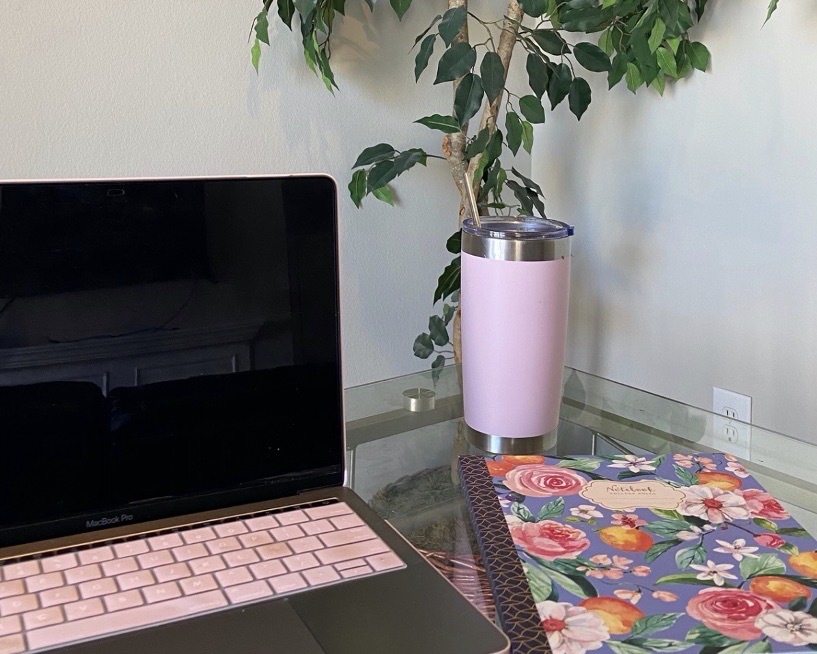
Much like the fluid situation we find ourselves in due to COVID-19 updates, your working space may be ever-changing as well.  As humans, we all have our preferences as to where and how we like to work.  If you are feeling like getting set up each day is taking as much time as the morning rush hour commute to campus, try these steps to find your best work space fit!


Grab your tools

What are the things you would never go to class without?  Those are the things you will need for your remote learning work space.  A computer, paper, pens/pencils should be the staples. If you’re like me, you need a little room to stretch out as well.

Stake out your space

What kind of environment do you need to be productive?  Think about the things that typically distract you and work from there to pinpoint a workspace where those distractions can be eliminated. 

Photo collage of three work from home desks

No desk?  No problem!

Get creative!  Throw a table cloth over a card table for an instant new desk!  Kitchen tables can work just as well.  Pull out a nightstand for some additional space or storage.  Just be sure you are staying organized!

Don’t get too comfy

Dedicate your work space for work and your sleep space for sleep.  However, consider bringing a pillow for a chair that may be less than ideal.  The key is to find a comfort level that will keep you alert but comfortable enough to watch an hour video lecture.   

Make it yours

Add a candle, a plant, or a picture of your friends that you are not getting much FaceTime with.  Create your work space to be a place you want to go!
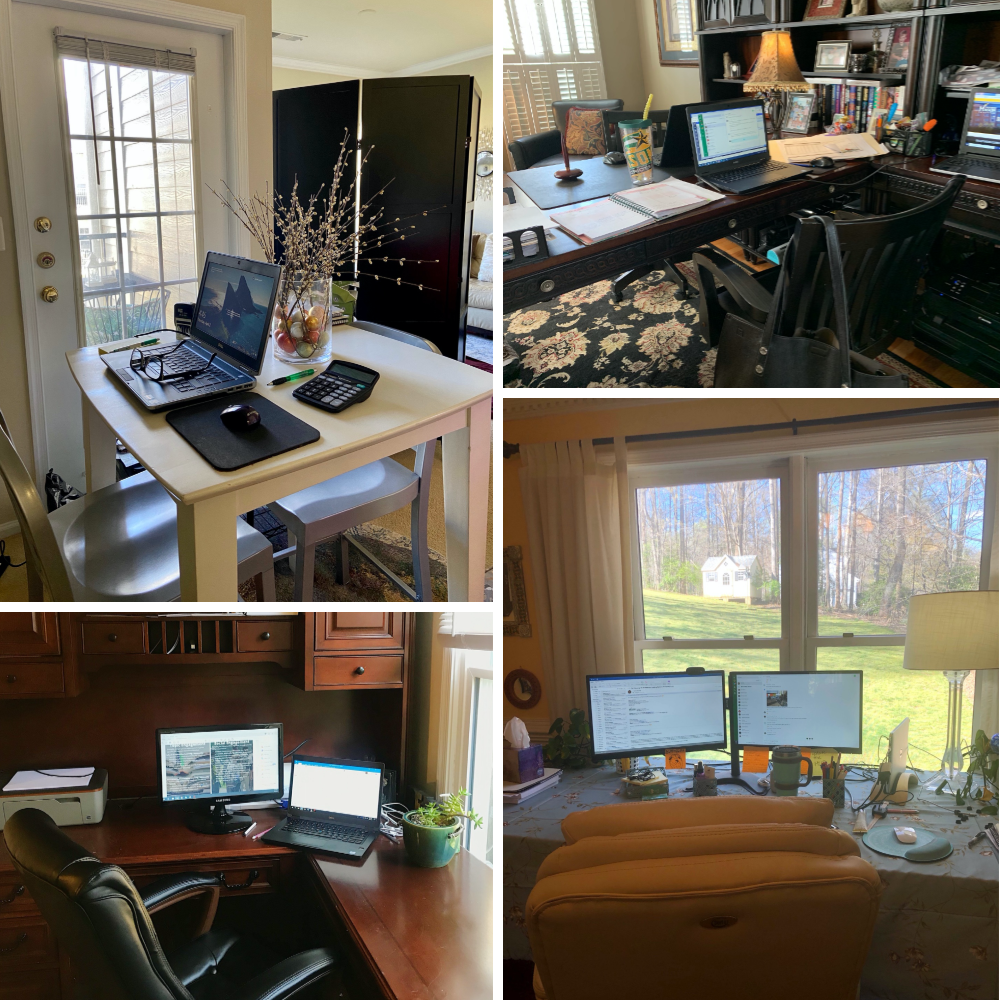
The workspaces in this article belong to the members of CEHD’s Student Success Team. Think you have a great set up?  Share it with CEHD_SAA on Instagram with the hashtag #CEHDWorksFromHome.  Be sure to check in next week for more steps to take on the road to academic success!
Wellness Tip of the Week: Moderate Your Media Intake

If being informed is beginning to impede on your sleep schedule, increase your anxiety, or introduce an enhanced sense of isolation or depression, it might be time to consider regulating your intake of information.

In a time as fluid as this, it’s no surprise that the masses are hungry for information. Consumers are searching day and night for any update related to the novel coronavirus, and the media is happy to oblige and provide news around the clock.

While the CEHD Student Success Team is a huge advocate of being informed, we also think it’s important to keep a firm grasp on your wellness, especially during a pandemic. If being informed is beginning to impede on your sleep schedule, increase your anxiety, or introduce an enhanced sense of isolation or depression, it might be time to consider regulating your intake of information.

So how do you create the perfect balance between being informed and being well? Try out our top three tips below.

  • Find credible sources: As a student, you’ve been told over and over again to cite credible sources; the same goes for gathering information about a crisis. Find a handful of reputable, reliable sources, and use them as your go-to’s when it’s time to catch up on COVID-19.
  • Schedule your screen time: Instead of reading or watching the news on an “as-needed” basis, try making an effort to check in on the status of coronavirus twice a day, perhaps in the morning and right after work or studies (early evening), and put a time cap on it. This will allow you to be informed at a time that works best for you, which will ultimately help you focus on other tasks throughout the day.
    • We recommend avoiding late-night check-ins, as taking in overwhelming information before bed may cause restlessness throughout the night.
  • Do your due diligence: Many people use social media to keep up with friends and family, especially during times like this. There’s nothing wrong with that! However, social media is swimming with misinformation disguised as “expert opinions.” Take “news” on these platforms with a grain of salt, no matter who shares it. For credible information, revert back to tip number 1.
    • If social media triggers your anxiety, you may consider limiting that, too. Small steps work well here – start by only checking your accounts once an hour, then every other hour, and so on, until you notice your wellness is back in check. It helps if you move the app on your phone to a less-accessible place (or delete it altogether); this way you have to think twice before finding and clicking the icon!

We hope these tips help you find some harmony in your new “normal.” Until our return, be well!  

On Next Week’s Blog: Host a virtual gathering, and follow through with it!

Brianna Alfors, CEHD Student Enrichment Coordinator

Brianna Alford is the Student Enrichment Coordinator for the College of Education and Human Development. When she’s not devising opportunities for CEHD students to Be Engaged, she enjoys cooking, crafting, and advocating for a proper RSVP.

I keep thinking about…

I keep thinking about…

…the student who relies on the computer lab in the JC to be open through the night because they don’t have a computer at home.

…the international student still living in the residence hall feeling alone and not sure if they can go back to their home country and then be allowed to return to the States when ready to continue their educational journey.

…the more seasoned student who isn’t as tech savvy and having to unexpectedly shift to remote learning for the very first time.

…the student who has a child who can no longer go to school or daycare and not quite sure how to balance parenting and being a student right now.

…the first generation college student who was excited to bask in celebration with their family at graduation.

…the student living in a small town that folks can hardly point out on a map who doesn’t have access to the internet.

…the work study student who is now strapped for hours and cash but still needs to cover their living expenses.

…the student who has had physical and mental health challenges well before coronavirus became an additional threat to their wellbeing. 

…the student who considers campus the only home and community that they have. 

I keep thinking about you, and I carry your stories and circumstances with me daily as I participate in response efforts to help loosen bottlenecks and break through barriers, seen and unforeseen, that stand in the way of your success here at Mason and beyond. 

Thinking of you,

Dr. Ivory Berry

Assistant Dean for Student Success

College of Education and Human Development

Dr. Ivory Berry

Procrastination, Motivation, and Avoiding Distractions

Try the 5-steps below in your first week of remote learning to avoid procrastination, distractions, and to stay motivated! 

Mid-semester is always a great time to check in on the goals we had set for ourselves in January when we were motivated, fresh, and ready to take on a new semester.  In the recent weeks our lives have been turned upside down and it can be difficult to feel motivated and driven in a brand-new environment at home.  Try the 5-steps below in your first week of remote learning to avoid procrastination, distractions, and to stay motivated! 

  • Have a dedicated work space– Don’t have a desk at home? Try the kitchen table!  Be sure you have a well-lit set up and a comfortable chair. 
    • Separate your academic hours from your resting hours as much as possible. Your bed is not a work space!
  • Create a distraction free environment-Turn your TV off and your brain on! Be sure to leave your phone in another room or at least on silent and face down.  If you need a little noise in the room try classical music or any music without words! 
    • Home with your family, children, or roommates? Break out the headphones!
  • 20 minutes on, 5 minutes off– It’s a marathon, not a sprint! Our brains can only handle so much at a time, and we may have other responsibilities surrounding us.  Try using a timer to work for 20 minutes and then break for 5 minutes.    
    • Children at home with you? Let the timer become a part of a game!  Try a 5-minute family dance party for a break. 
  • Dress for success– What are you going to wear to the living room today? Be sure you are getting up, getting ready, and heading to your work space.  Last nights pajamas will leave you feeling tired and unmotivated. 
  • Find your procrastination stations– Where do you go (physically or virtually) when you find yourself drifting? Usually, I find myself at the refrigerator!  This is when I know I need more than a 5-minute break. Try to take a walk, head into a different room, or just stand and stretch for a bit. 

Ask for help!  If you feel you are struggling with finding the best environment for you reach out to your support systems like the College’s Student Academic Success Coordinator, Stormi Woltz!

Yours from afar,

Stormi Woltz

Important Information for Educator Preparation Students

TO:                 Student Completing Field Experiences and/or

                       Internships in Mason’s Educator Preparation Programs

FROM:           Roberto A. Pamas, Ed.D

                       Director, TeacherTRACK @ Mason

RE.:                Update (as of 3/23/2020) from TeacherTRACK @ Mason regarding Field Experience

                       and Internship:

We know that there are many questions that you may have regarding the requirements for and associated opportunities to complete your field experience and internship. It is my hope that this communication will provide you with information that can answer some of your questions, as the situation remains very dynamic. I am confident that there soon will be additional information and greater clarity.

As the Coronavirus Crisis continues to unfold, as it’s a rapidly changing situation, we will provide updates with information as issues become more well defined, and decisions are made both by the Virginia Department of Education (VDOE) and the School Divisions of the Commonwealth, as well as by our university. Some issues remain ambiguous and uncertain as school divisions continue to monitor the context and consider if, or when, classes will continue during the spring semester.

However, despite the ambiguities (that we cannot control) we remain confident that our students who are in the midst of field experience and/or internship will either be able to complete the state’s requirements, or the state will grant exceptions so that you will complete your degree and the requirements for your Virginia license. However, now is time for patience as the public health crisis continues to evolve and as we seek further clarity from the state and decisions are made by the Commonwealth and Virginia’s school divisions.

Please check regularly for updates that will be sent in addition to the frequently asked questions below.

FAQs:

  • Will I be able to graduate in May and qualify for a Virginia license with only completing part of my internship?

We are in close and regular contact with Virginia Department of Education about this and are advocating for modifications that will allow you to still meet the requirements for successful completion of field experience and/or internship. We are confident that the state will be flexible and will formulate an approach for the waiving of some requirements

We advise you to log and maintain a record of your overall direct/indirect hours completed, as well as the number of weeks of field experience and/or internship completed, prior to the closure of schools in response to the Coronavirus Crisis.  In addition, we also advise you to document and log the following: 1) total number of virtual hours instruction to PK-12 students that you have completed since the closure of schools, 2) practicum experiences prior to field experience and/or internship, and 3) total number of hours supporting and/or participating in distance learning with mentor teachers.

  • Licensure Testing: Since most testing centers have closed; what guidance and/or flexibility can the Virginia Department of Education provide for students who cannot take their required exams for Virginia licensure?

The Virginia Department of Education is aware of and is considering this issue. They will provide specific guidance in the near future.

  • What will happen if school districts remain closed for the remainder of the 2019 – 2020 academic year?

Mason: University instructors and supervisors will provide additional guidance and/or alternative learning assignments to meet Mason’s required course objectives.

School Districts: We are in close contact with all partner school divisions to advocate for your participation in any remote learning and/or online programs as part of your field experience and/or internship that may begin in their schools as a means to support your continued learning needs. 

For example, for students completing field experiences and/or internships in the Fairfax County Public Schools (FCPS), FCPS recently (3/20) provided this commitment:

“While we have no way to predict how the days ahead will unfold, FCPS is prioritizing the safety of its students, employees and community. At this point, FCPS has not yet enacted a distance learning plan, however; in the event FCPS does move toward a distance learning model, (Mason) student teachers should have access to FCPS 24-7 (Blackboard), the platform that would be used for distance learning.”

  • How will this pandemic impact your job search with school districts?

Mason: You should stay in close contact with Mason’s Career Services to continue exploring employment opportunities as they become known and more information is available. Indeed, we are confident, and fully anticipate, that school divisions will identify mechanisms for the recruitment, selection and hiring of teachers, and other personnel, for academic year 2020 – 2021.

School Districts: We will update you as we receive information from school divisions.  Most recently, for example, Fairfax County Public Schools (3/20) announced that they have “already offered several recruitment contracts for teaching assignments this coming fall” and will continue to interview for expected openings. We understand that other school divisions also soon will continue their recruitment and hiring initiatives. Additional information will be forthcoming.

Some Final Thoughts

It is suggested, and encouraged, that you stay in close contact with your mentor teacher and university supervisor. If there are questions that they cannot provide answers for you, do not hesitate to contact me, Dr. Roberto Pamas, Director of TeacherTRACK @ Mason at: [email protected] .

While we are dependent upon Virginia Department of Education policies and associated regulations, as well as local school division guidelines and practices, which might at times slow our efforts in getting information to you, we will continue to share information as it becomes available related to the impact of the Coronavirus Crisis on your academic program and learning needs, state regulations governing the requirements for licensure, school division practices and associated career opportunities.

In the meantime, as best as you can, please take time to care for yourselves and your family.

All the best – stay safe, healthy and well.